My Findings - How Small Business Websites Can Improve SEO
Many small business websites struggle to generate traffic, enquiries, or sales not because they lack good products or services, but because they overlook some of the fundamentals that help search engines and users understand their website.
After carrying out several SEO audits for small Devon businesses in different sectors, I found that the same issues appeared. While every business is different, these are some of the most common opportunities for improvement.
1. Add Good Meta Information
Meta data is hidden in the website source code. It provides search engines with information about the page and how to display it. Meta information isn't visible to the user, it is coded in the header of the document.
Often, meta titles and descriptions are missing, duplicated, or fail to describe the purpose of the page clearly.
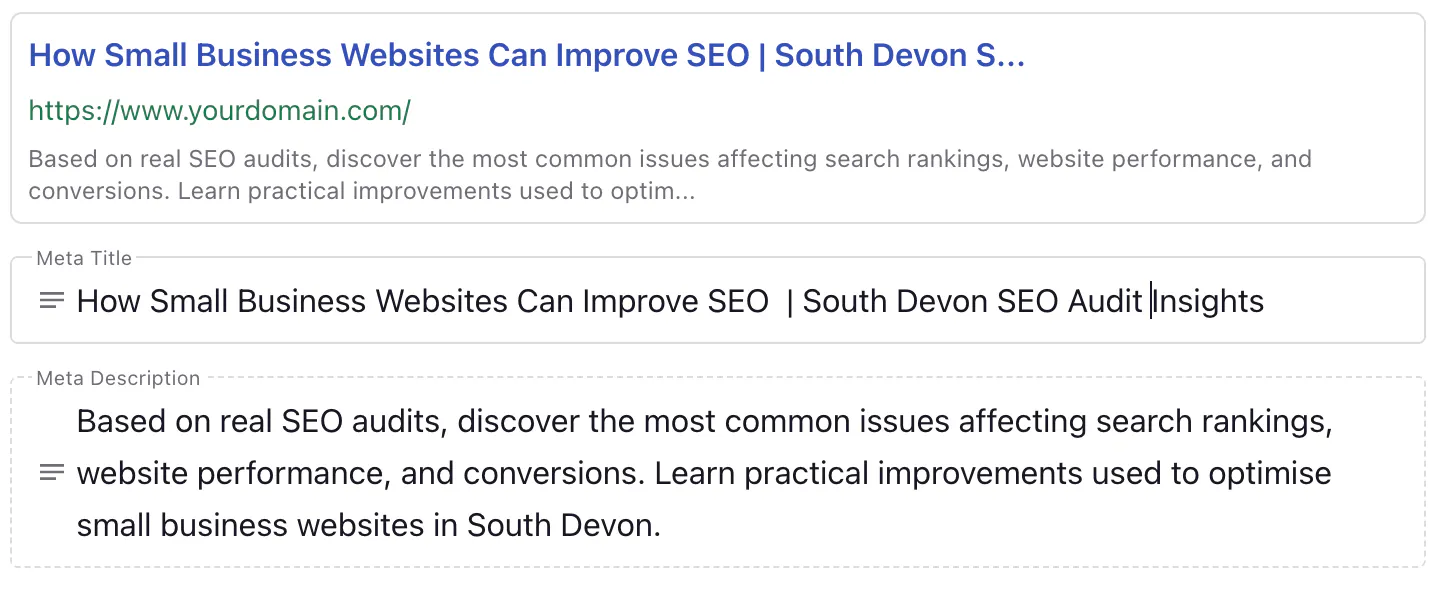
The example above illustrates how search engines use meta title and description in search results.
A good meta title should communicates what the page is about, who it is for, and where is relevant, for example, the location or service area.
A good meta description should encourage people to click on your website while accurately describing the content of the page.
Read more about Google's guidance on meta descriptions
2. Focus On Semantics
Semantics gives meaning to information, enabling algorithms to understand context, identify relationships, and connect related data. On the web, semantic technologies transform information into an intelligent, interconnected knowledge base that can be queried to discover linked facts and deeper insights.
Create Good Semantic Structure
Semantic structure is the practise of using HTML tags to organise, and describe the meaning and role of the content on a web page. Semantic elements define different parts of the web page, for example, <header>, <nav>, <section>, <main>, <article> etc. Using appropriate elements to describe content helps search engines understand its meaning and relevance on the webpage and the website.
Keep Page Purpose Focused
Many websites try to communicate too many things at once. Search engines and users both benefit when each page has a clear purpose. For example, a service / product page should explain one service / product and pricing pages should explain pricing. When multiple objectives are combined on a single page, it can dilute relevance for search engines and create confusion for users. As a result, pages may rank less effectively and convert fewer visitors because users are uncertain about the information they will find.
Create Good Heading Structure
Headings help both users and search engines understand the structure, relevance, and importance of content on a page. Common issues include missing or multiple H1 tags, headings used primarily for visual styling rather than content structure, and an inconsistent heading hierarchy.
A well-structured page typically contains a single H1 heading that introduces the main topic, H2 headings that define major sections, and H3 headings that support and organise subsections.
A clear heading hierarchy makes content easier for users to scan and navigate while helping search engines better understand the relationships between topics and the overall page context.
Add Internal Links
Internal links are links that connect pages within a website. Internal links are crucial for users and search engines because they provide the backbone of a website. Search bots crawl this backbone by following links within each page, without them, these become orphaned and undiscovered.
Many websites contain useful information, but related pages are not connected together. Internal links help search engines understand the relationship between pages, guiding visitors to relevant content whilst also improving the visibility of important pages in search results.
For example, a service page should often link to pricing, case studies, related services and contact information.
3. Add Structured Schema Data
Schema markup is structured data that is added to the website code. It is written in JSON-LD and provides additional information about the content or the business. Schemas helps search engines understand content and can improve how pages appear in search results.
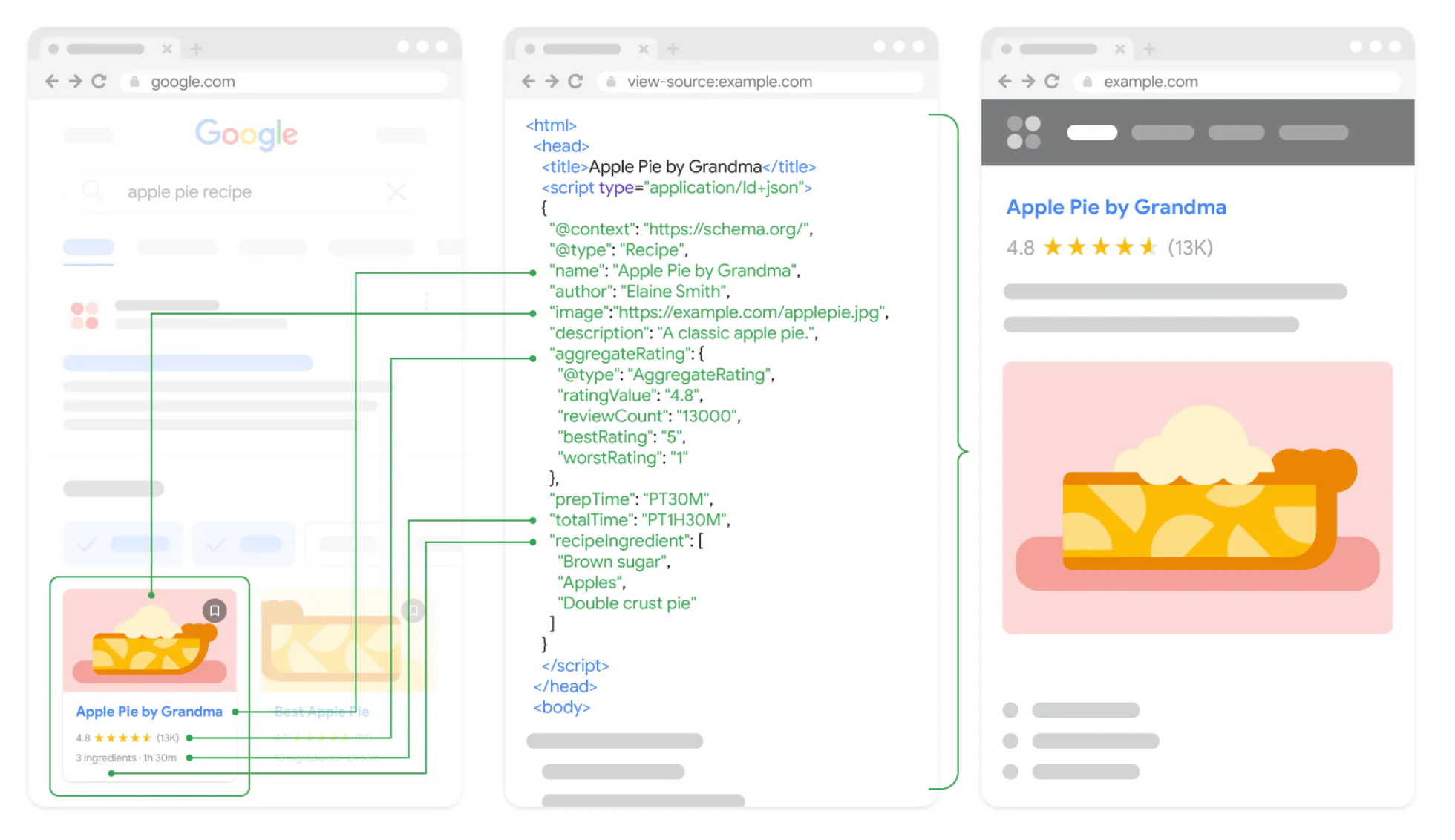
In the example above, because the structured data labels each individual element of the recipe, users can search for recipes by ingredient, calorie count, cook time, and so on.
Read more about schemas on Google's documentation on structured data
4. Add Calls-to-Action
Many websites focus on attracting visitors but pay less attention to what happens after a user arrives. Effective websites are built around user intent and are designed to support visitors throughout their journey to conversion. Each web page should help users take the next logical step towards their desired outcome, whether it be seeking information, comparing solutions, making a purchase, contacting a business, or subscribing to updates
Search visibility is only one part of success. The greatest value comes from turning visitors into engaged users, leads, customers, or subscribers through clear navigation, relevant content, and purposeful calls to action.
Calls to action can take many forms, including links, buttons, forms, and online payment functionality. They should use clear, action-oriented language that highlights the benefit of taking the next step. For example, “Join our weekly newsletter”, “Download the guide”, or “Reserve your place today”. Strong calls to action help users understand what to do next and why it is worthwhile.
5. Add Analytics and Reporting
Tools such as Google Analytics, Google Search Console, Microsoft Clarity, and Lighthouse provide valuable insights that support better business decisions.
They can help businesses understand where visitors to their website are coming from, which pages perform best, what users click, and where users leave the website.
Monitoring the search terms that bring visitors to your website can provide valuable insights into user behaviour, content performance, and search visibility. By understanding how people find your website, organisations can identify which topics and pages are attracting traffic, uncover new content opportunities, and spot areas where content may not be meeting user needs.
Search term data can also reveal differences between the language used by an organisation and the language used by its audience. These insights can help improve page titles, headings, content, and navigation to better align with user intent.
6. Ensure Your website is Technically Sound
Technical SEO is the foundation of a well-performing website. While it is often less visible than content or design, technical issues such as slow page loading, broken links, accessibility barriers, indexing errors, and poor mobile usability can prevent users and search engines from accessing content effectively.
Tools such as Google’s PageSpeed Insights and Lighthouse provide valuable insights into technical performance and can help identify areas for improvement. Regular monitoring and maintenance help ensure a website remains fast, accessible, and easy for search engines to crawl and index.
SEO Is an Ongoing Process
One of the biggest misconceptions about SEO is that it is a one-off task. Search engines, competitors, customer behaviour, and business priorities change continuously. The most successful websites are regularly reviewed and improved based on evidence, data, and user behaviour. Whether you're managing your own website or working with a specialist, the goal should be to create content that is useful, technically sound, easy to navigate, and aligned with what your customers are actually searching for.
If you'd like to me to conduct an SEO audit and proposal for improvement of your website, please get in touch.