
How to Write Website Content That People and Search Engines Understand
Understanding How Your Customers Search for your Products or Services
Good website content begins with understanding how your customers search for your products or services. One of the most common mistakes businesses make is describing what they do using internal or industry-specific jargon rather than the words their customers actually use, or focusing on what they can do rather than how they can help. Before writing a page, ask yourself, “What would someone type into Google if they were looking for this service?”Your page title, headings, and body content should naturally answer that question.
Choosing High-Value Keywords
High-value search keywords are more likely to attract high intentional visitors that has a higher chance of resulting in meaningful business value like a sale, enquiry, booking or qualified lead. For example, a person searching with a google term "web design", is less likely to result in a conversion. Conversely, a person using a search term "web design South Devon small business" is more likely to be visitor with high intent. High-value keywords can be transactional - "get your free seo report", problem led: "improve your seo", service & location: "small business web developer in South Devon", or brand terms: Beam Beam Digital, South Devon, Website builder".
Think about the specific words and phrases your customers are likely to search for. For local businesses, this often means combining your service with a location, for example “Website Design South Devon”, “Handmade natural artisan soaps, South Devon”, or “Holiday Cottage Totnes”. If you serve multiple locations, create dedicated pages that provide useful information about each area rather than simply repeating place names throughout your website. Search engines reward content that is relevant, informative, and genuinely useful to local audiences.
Research What Keywords Website Visitors Use
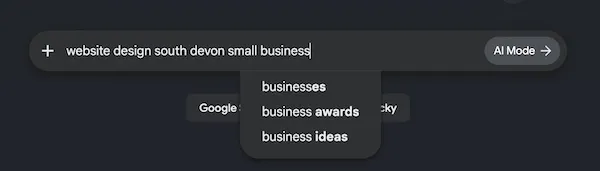
Research before you write. Google’s autocomplete suggestions (see screenshot below),
the “People also ask” section (see screenshot below),
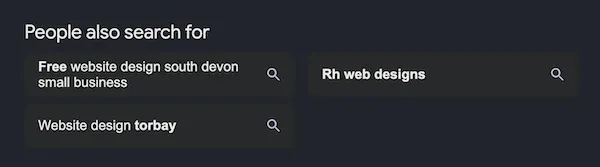
and the related searches at the bottom of search results (see screenshot below)
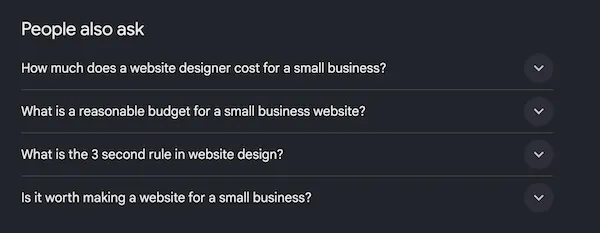
are excellent free sources of information because they reflect real searches made by users.
Write for People First and Search Engines Second
Your content should:
- Answer the questions your customers are asking
- Explain your services clearly
- Include a call-to-action that guides visitors towards the next step in their user journey. Ultimately, the user journey should answer a question, build truth and credibility, and end in a conversion, whether that is contacting you, requesting a quote, or making a booking.
Avoid repeating keywords unnaturally or filling pages with generic marketing phrases such as “high-quality service” or “industry-leading solutions” unless you can support those claims. Search engines increasingly recognise content that demonstrates genuine expertise, experience, and usefulness.
Each Website Page Should Have a Single Purpose
Finally, remember that search engine optimisation is not about individual keywords but about communicating clearly. Every page should have a single purpose, a descriptive page title, a clear heading structure, and content that matches the intent behind a user’s search. The better your website answers your customers’ questions, the easier it becomes for both search engines and artificial intelligence systems to understand your content and recommend it to the right audience.
Review your Copy
When writing copy for a page,
- Does this page answer a specific customer question?
- Does the page title describe exactly what the page is about?
- Would your customers use these words when searching?
- Have you included your location naturally where appropriate?
- Does the page explain what makes your business different?
- Is there a clear call to action?
- Would this page still be useful if Google didn’t exist?
That last question is particularly important. Modern search engines and AI systems increasingly reward content that demonstrates genuine expertise and usefulness rather than content written primarily to manipulate rankings.
If you'd like to me to review your content for search engine optimisation please get in touch